

EKHON | Feature
Ukhrul, Manipur | EKHON: For five decades, the Naga political movement has endured armed confrontation, internal divisions, negotiations, and shifting geopolitical realities. In an extended and deeply ideological conversation, RH Raising, Special Emissary to the Collective Leadership NSCN/GPRN, who commemorated 50 years of his service on 27 February 2026 reflected on what he describes as a lifetime shaped by struggle, survival, faith, and an unfinished political question between the Nagas and India.
His narrative moves between history, theology, nationalism and grievance, revealing how sections of the Naga movement continue to interpret their struggle not merely as a political negotiation, but as a civilizational and existential battle.
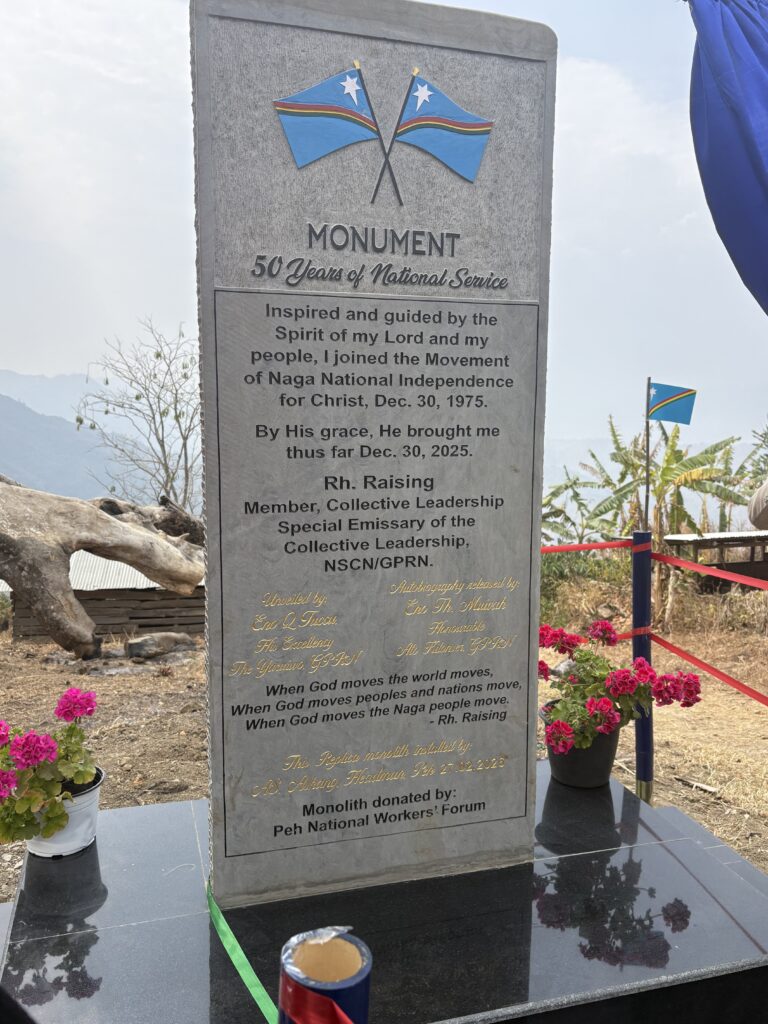
According to Raising, the early decades of the movement were defined by intense military pressure and fragmentation. He alleged that multiple armed and political forces were mobilised against the National Socialist Council of Nagalim (NSCN), including rival Naga groups, regional insurgent organisations, and state-backed security forces operating across India and Myanmar.
Despite these pressures, he claims, the organisation survived through ideological conviction and collective resilience.
“We survived by His grace,” Raising said, framing survival itself as proof of legitimacy. “Every coalition was formed to uproot us, yet the movement endured.”
This endurance, he argues, eventually compelled New Delhi to initiate political dialogue.
Raising traces a turning point to the mid-1990s, when negotiations began with the Union Government of India during the tenure of former Prime Minister P. V. Narasimha Rao.
He recalled three principles that, according to him, guided the talks; Dialogue at the Prime Ministerial level, no precondition imposing the Indian Constitution and negotiations to be held outside India. These discussions eventually culminated in the 2015 Framework Agreement, signed on August 3 between Naga negotiators and the Union Government of India.
For Raising, the agreement represented recognition, at least in principle, of distinct Naga political identity.
Despite the agreement, Raising accused Indian institutions of attempting to dilute earlier understandings through the creation of rival negotiating groups and factions.
He dismissed competing Naga political formations as externally engineered, insisting that his organisation alone carries what he calls the mandate of the Naga people.
Recent tensions in peace negotiations with India, he said, stem from dissatisfaction with bureaucratic-level interlocutors, like the present AK Mishra, arguing that political issues require political engagement rather than administrative mediation.
“The issue is political,” he said. “It cannot be settled bureaucratically.”
A recurring theme throughout the interview was the distinction Raising draws between coexistence and constitutional integration.
He argued that coexistence should resemble relations between separate political entities rather than absorption into India’s constitutional framework. According to him, acceptance of the Indian Constitution would effectively end Naga political claims to sovereignty and identity. This belief also shapes his explanation for cultural assimilation.
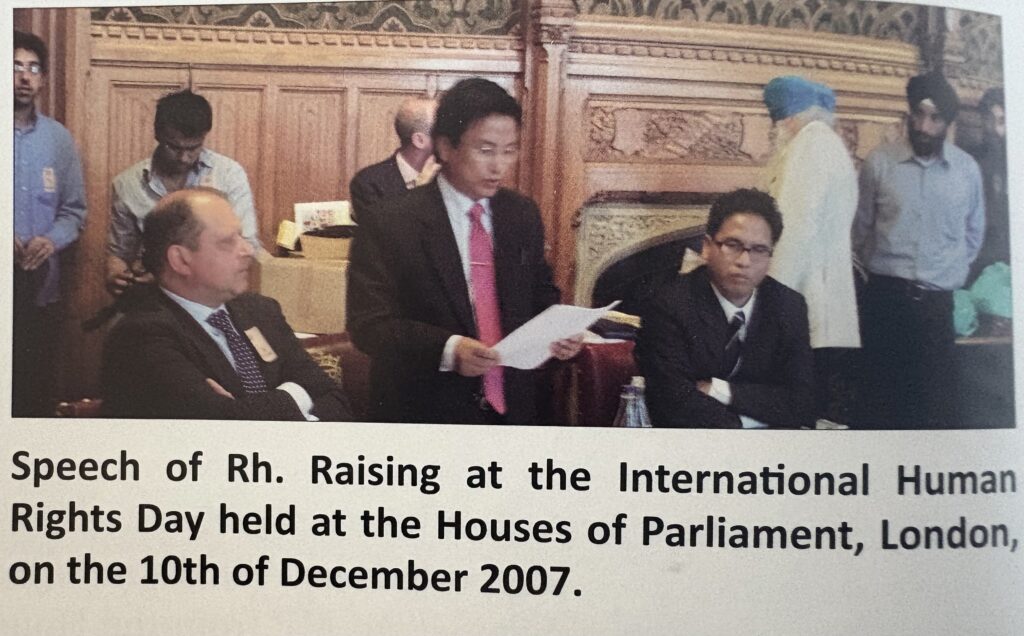
When he was asked, why many Nagas know more about Indian history and institutions than their own?
His answer was blunt: governance structures, education systems and administrative authority remain controlled by Indian institutions, making India the “deciding factor” in everyday life.
Only after a final political settlement, he claimed, would Nagas fully institutionalise their own laws, administrative systems and cultural frameworks.
Unlike purely secular nationalist movements, Raising repeatedly grounded the Naga struggle in Christian belief. He described the movement as guided by a moral and spiritual concept, “Nagalim for Christ”, though he clarified that it does not seek the creation of a theocratic state.
Faith, in his view, functions as a foundational ethic shaping family, village governance and national aspiration.
“Concept comes first, revolution next,” he said, arguing that nations emerge from shared ideological vision rather than territory alone.
Addressing recent tensions between Tangkhul Naga and the Kukis in Litan, Ukhrul district of Manipur, Raising offered sharply critical views on ethnic conflicts involving neighbouring communities, alleging external manipulation and territorial competition.
He framed such confrontations as defensive struggles over ancestral land rather than political disputes, asserting that Nagas would resist any perceived encroachment.
His remarks reflect the deep mistrust and competing historical narratives that continue to complicate peace-building across Manipur’s hill regions.
Looking back on half a century in the movement, Raising portrayed revolutionary life as sacrifice rather than glory. Borrowing from revolutionary rhetoric associated with Mao Zedong, he described armed struggle as defined by hardship, hunger and loss rather than heroism.
He also referenced the Shillong Accord as a moment he believes threatened to end Naga political aspirations, a development he maintains was reversed by the resurgence of the movement.
For Raising, revolution remains inseparable from hope.
“So long as there is a revolutionary,” he said, “there is hope for the people.”
For Raising, history, faith and politics are not abstract ideas but deeply personal truths, woven together into a lifelong commitment to what he sees as the unfinished struggle of his people.
Even after decades of ceasefire and dialogue, the Indo-Naga issue remains unsettled, suspended between competing definitions of sovereignty, coexistence and identity.
For leaders like RH Raising, the struggle is not yet concluded. The central question, as he sees it, is not merely territorial or administrative, but philosophical.
‘Who decides the future of the Nagas, Delhi, or the Nagas themselves?’
Until that question is resolved, he suggests, the movement will continue to define itself through resistance, belief and the enduring idea of nationhood.
(The feature is based on the long conversation EKHON had with RH Raising on February 27, 2026 at Peh village. Not to be replicated without permission.)
