

Contributed by Mansak Ngalung and Semmichon Zimik
1st Year Student, Department of Social Work
St. Joseph College, Ukhrul
Ukhrul, Manipur | EKHON: Our rural camp in Challou Village undertaken by the Department of Social Work, St. Joseph College, Ukhrul, from 14th to 18th April, was a deeply meaningful experience marked not merely by observation but by genuine human connection. Beyond the visible realities of rural life, we encountered a community rooted in warmth, unity, generosity, and compassion. What stood out most was the village’s leadership. The dedication and sincere concern shown by the villagers, led by Headman Leishisan A. Shatsang, Secretary Thotreiyo A. Shatsang, Accountant Solem A. Shatsang, and Woryao Lungleng, created a safe and reassuring environment. Their leadership reflected responsibility, cooperation, and genuine care, making unity not only visible but deeply felt.
This experience reaffirmed a powerful truth: compassionate leadership shapes the spirit of a community. The harmony in Challou Village shows that when leaders act with integrity and empathy, people come together. It also reflects deeply rooted cultural values—unity, respect, and collective living—highlighting that good leadership is foundational to peace.
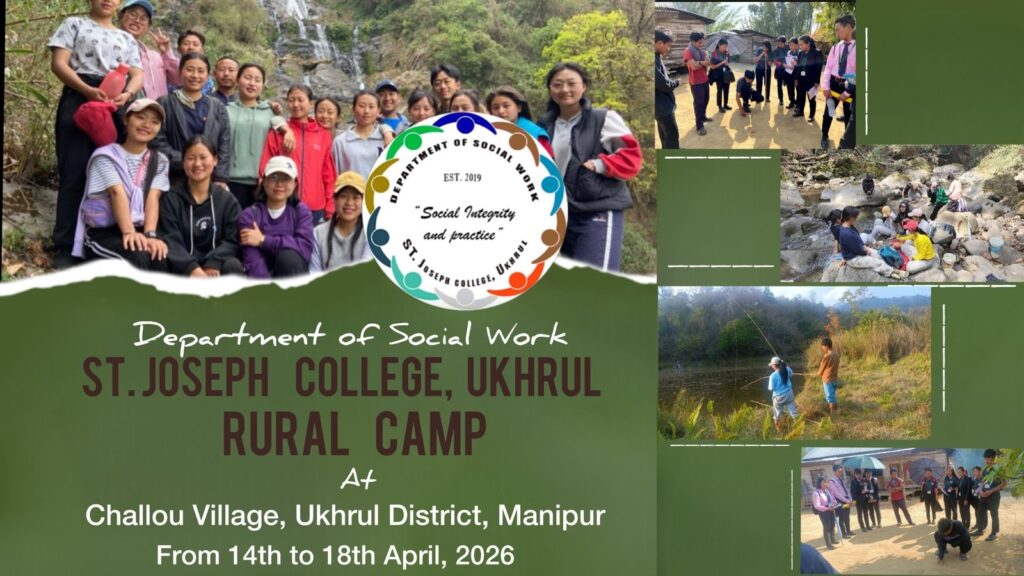
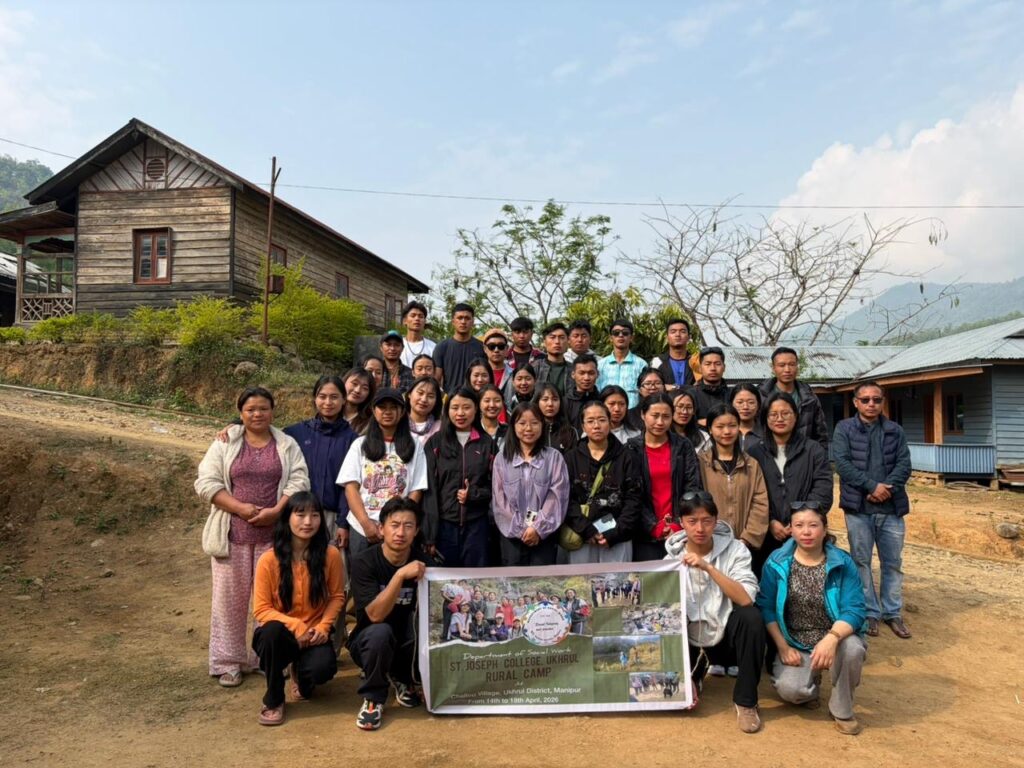
The village’s cleanliness was another striking feature. Every corner reflected discipline, awareness, and shared responsibility, showing that development depends not only on resources but also on mindset and collective effort. Equally touching was the villagers’ generosity. They gave wholeheartedly, often placing our needs over their own. From folktales to traditional practices like salt-making, each interaction became a meaningful exchange of knowledge and experiences, teaching us humility and the importance of preserving culture.
Our fieldwork involved Participatory Rural Appraisal (PRA) tools such as social mapping, resource mapping, mobility mapping, ranking and scoring, transect walks, historical timelines, and seasonal calendars. These methods deepened our understanding of the village’s social structure, resources, challenges, and cultural evolution. Our visit to the Village Government School was equally meaningful. We engaged with around 22 children through songs, stories, games, and colouring activities. In addition, an awareness session on the Protection of Children from Sexual Offences (POCSO) Act and basic sexual health was conducted for both boys and girls, aiming to promote safety, awareness, and age-appropriate understanding among the students.
A memorable highlight was the visit to the famous salt-producing site, where we learned traditional methods of extraction and its cultural and economic significance, including its role in natural healing. Another enriching activity was fishing using traditional methods involving tree barks, led by village youth, reflecting strong community participation and indigenous knowledge. Evenings spent with village youth and elders were filled with warmth, songs, storytelling, dance and cultural exchange, strengthening our bond with the community and creating lasting memories. These experiences went beyond an academic exercise, shaping us into more empathetic listeners, observers, and future social workers. The greatest learning came from the villagers themselves—their hospitality, unity, and way of life.
Greater government support, particularly in infrastructure such as healthcare, electricity, transportation etc., would significantly enhance the well-being of Challou Village and enable fuller utilization of its human and natural resources. We express our sincere gratitude to our faculty members—Dr. Sword Ronra Shimray, Miss Chonchui Magdalene C.S., and Dr. Thanmung Khariwo for their guidance and support. We remain deeply indebted to the people of Challou Village for their invaluable lessons and hospitality.
